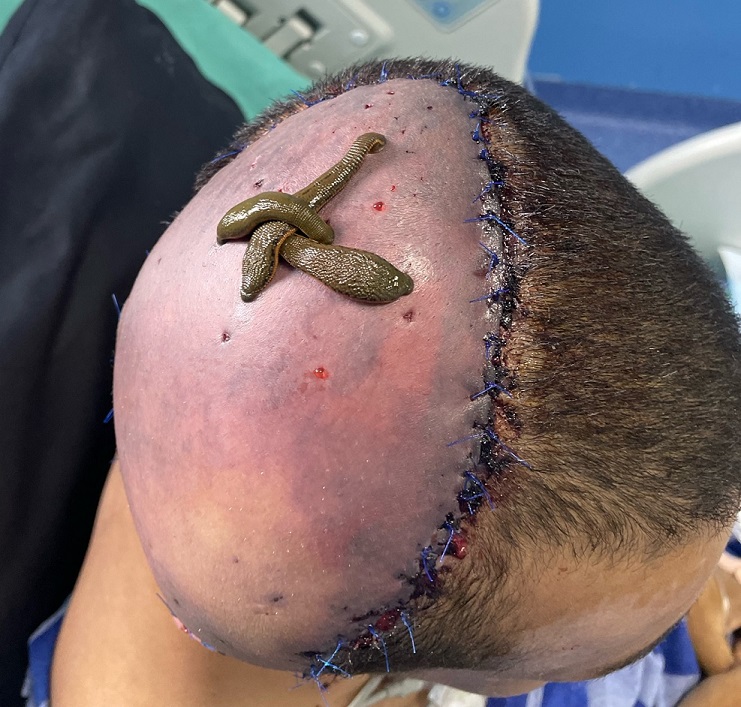
A 17-year-old male sustained deep fourth-degree high-voltage electrical burns with an open, decompressed skull fracture involving the vertex and right parietal region. Following burn stabilisation, serial debridement, and mini-craniectomy, definitive coverage was achieved using an anterolateral thigh free flap. In the early post-operative period, the flap developed venous congestion, threatening flap viability. In our resource-limited setting, immediate microsurgical re-exploration was not feasible. Medicinal leech therapy (hirudotherapy) was initiated as a salvage measure under close monitoring and antibiotic therapy. Serial applications resulted in a progressive reduction in congestion and an improvement in flap perfusion. Each applied leech can be expected to consume 5-20 mL of blood during a feeding, which may last from 15 to 120 minutes. The salivary glands of leeches secrete numerous bioactive substances that provide analgesic, anti-inflammatory, antioxidant, platelet-inhibitory, anticoagulant, thrombin-regulatory functions, and antimicrobial effects. This centuries-old therapy is also used for the treatment of vein problems, arthrosis, or pain relief. Medicinal leeches are a United States Food and Drug Administration-approved treatment for venous congestion in graft tissue to promote healing. Within plastic surgery, the predominant role of leeches is to relieve venous congestion in compromised flaps. However, due to the absence of robust randomised controlled trials, the quality of the scientific evidence is rated as moderate and is limited to retrospective case series. Risks of leech therapy include infections (especially Aeromonas hydrophila) as the most reported complication and prolonged bleeding.
Corresponding Author
Andreas Holstein, Department of Critical Care, Kirtipur Hospital, Devdhoka, Kirtipur, Nepal (Andreas.Holstein@t-online.de)