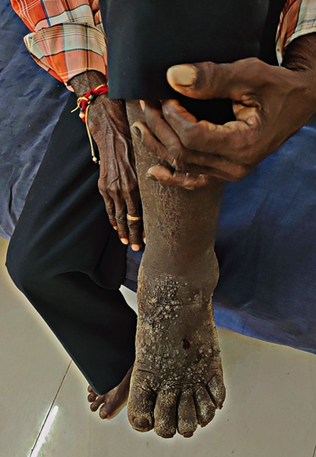
A 58-year-old male agricultural laborer presented with progressive swelling and thickening of the left lower limb for the past 8 years. The condition began as mild, pitting edema of the foot that gradually progressed to non-pitting swelling with hardening of the skin. Over the last 2 years, he developed marked hyperkeratosis, fissuring, and verrucous plaque formation over the dorsum of the foot, accompanied by occasional serous discharge and difficulty in walking. He reported no history of diabetes, trauma, or chronic venous disease. On examination, the affected foot showed massive enlargement, thickened skin folds, diffuse hyperpigmentation, and coarse, “mossy” papillomatous projections-features characteristic of elephantiasis. Based on clinical presentation, a diagnosis of chronic lymphedema with elephantiasis, likely secondary to long-standing lymphatic obstruction, was made. The patient was treated with tablet lasix 10 mg once daily, tablet chymoral forte one tablet twice daily, and tablet zerodol-sp one tablet twice daily. Following treatment, the patient showed mild improvement in edema. Early identification and regular lymphatic care are essential to prevent irreversible deformities. Chronic lymphedema is a progressive disorder characterized by impaired lymphatic drainage leading to persistent tissue swelling and skin changes. Long-standing disease may result in severe hyperkeratosis, verrucous plaques, and papillomatous overgrowth, a condition referred to as elephantiasis. These changes predominantly affect the lower limbs and are associated with significant functional impairment and risk of secondary infections. The image is useful in differentiating between post-inflammatory lymphedema, Malignancy-related lymphedema and myxedema.
Corresponding Author
Shreya Parkhi, Department of Kayachikitsa, Mahatma Gandhi Ayurveda College Hospital and Research Centre, Datta Meghe Institute of Higher Education and Research, Salod (H), Wardha, Maharashtra, India (shreyaparkhi22@gmail.com)