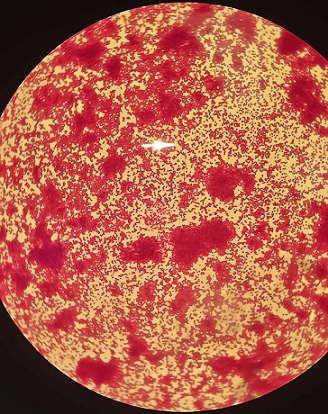
A 47-year-old woman underwent transsphenoidal surgery for resection of a meningioma and was admitted to the intensive care unit (ICU) for postoperative monitoring. During her intensive care unit stay, she developed high-grade fever associated with progressive deterioration of consciousness. Lumbar puncture was performed due to suspicion of central nervous system infection. The Spinal fluid was macroscopically turbid. Direct microscopic examination after Gram staining revealed numerous small Gram-negative coccobacilli predominantly arranged in diplococcoid forms, diffusely distributed across the microscopic field (image). This pleomorphic morphology initially suggested Gram-negative diplococci but was compatible with <i>Acinetobacter</i> species. Cerebrospinal fluid culture subsequently confirmed <i>Acinetobacter baumannii</i> with a multidrug-resistant profile, susceptible only to colistin and tigecycline. Despite targeted intravenous colistin therapy and intensive supportive care, the patient's condition rapidly deteriorated and resulted in death. Given the transnasal surgical approach and the temporal association with nasogastric tube insertion during the ICU stay, an ascending nosocomial infection was strongly suspected. This image highlights the diagnostic importance of recognizing the characteristic direct microscopic appearance of <i>Acinetobacter baumannii</i>, which may be misleading, and underscores the critical role of strict aseptic technique and infection-prevention measures during routine invasive procedures.
Corresponding Author
Didi Mehdi, Intensive Care Unit, University of Caddy Ayad, Military Hospital of Avicenne, Marrakech, Morocco (dr.mehdididi@gmail.com)