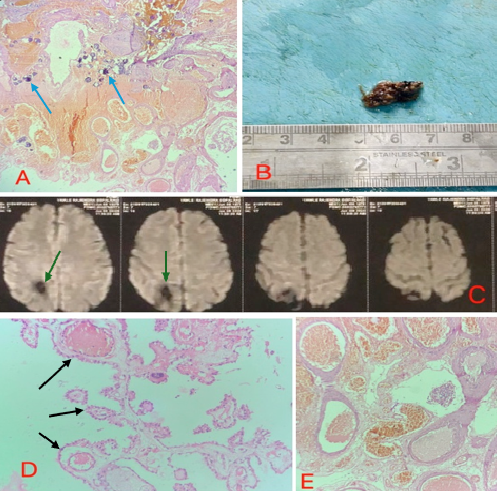
Choroid plexus papilloma (CPP) is a rare, benign epithelial tumor of the central nervous system, accounting for 0.4–0.6% of brain tumours. Arising from the choroid plexus, which produces cerebrospinal fluid (CSF), CPPs usually grow slowly and lack metastatic potential. They are more frequent in children, typically in the supratentorial region, while in adults they occur predominantly in the infratentorial compartment. Clinically, CPPs often cause hydrocephalus and raised intracranial pressure due to CSF overproduction or obstruction, presenting as headache, nausea, vomiting, or altered sensorium. MRI is the preferred diagnostic tool, aiding assessment of tumor size, vascularity, and relation to adjacent structures. Surgical excision remains the treatment of choice and generally ensures a favourable prognosis. We present the case of a 50-year-old male with a one-month history of persistent headache and dizziness, without seizures, vomiting, or neurological deficits. Examination and laboratory results were normal. MRI suggested a vascular malformation in the right parietal lobe extending into the choroid plexus. The patient underwent uneventful surgical excision under general anaesthesia. Grossly, the specimen was an irregular, brownish-black fragment with a bosselated surface. Microscopy revealed papillary fronds with delicate fibrovascular cores lined by low columnar epithelium, scant stroma, and dystrophic calcification features diagnostic of CPP. Unlike normal choroid plexus tissue with its “cobblestone” pattern, CPP lacked apical intercellular separations. According to WHO classification, CPP is Grade I, with atypical and malignant variants showing increased mitotic activity. The patient was discharged in stable condition and advised regular neurosurgical follow-up. This case emphasizes considering CPP in adult intraventricular or periventricular lesions despite its rarity.
Corresponding Author
Nirlipta Swain, Department of Pathology, Jawaharlal Nehru Medical College, Datta Meghe Institute of Higher Education and Research, Sawangi (Meghe), Wardha, Maharashtra, India (nirliptaswain16@gmail.com)